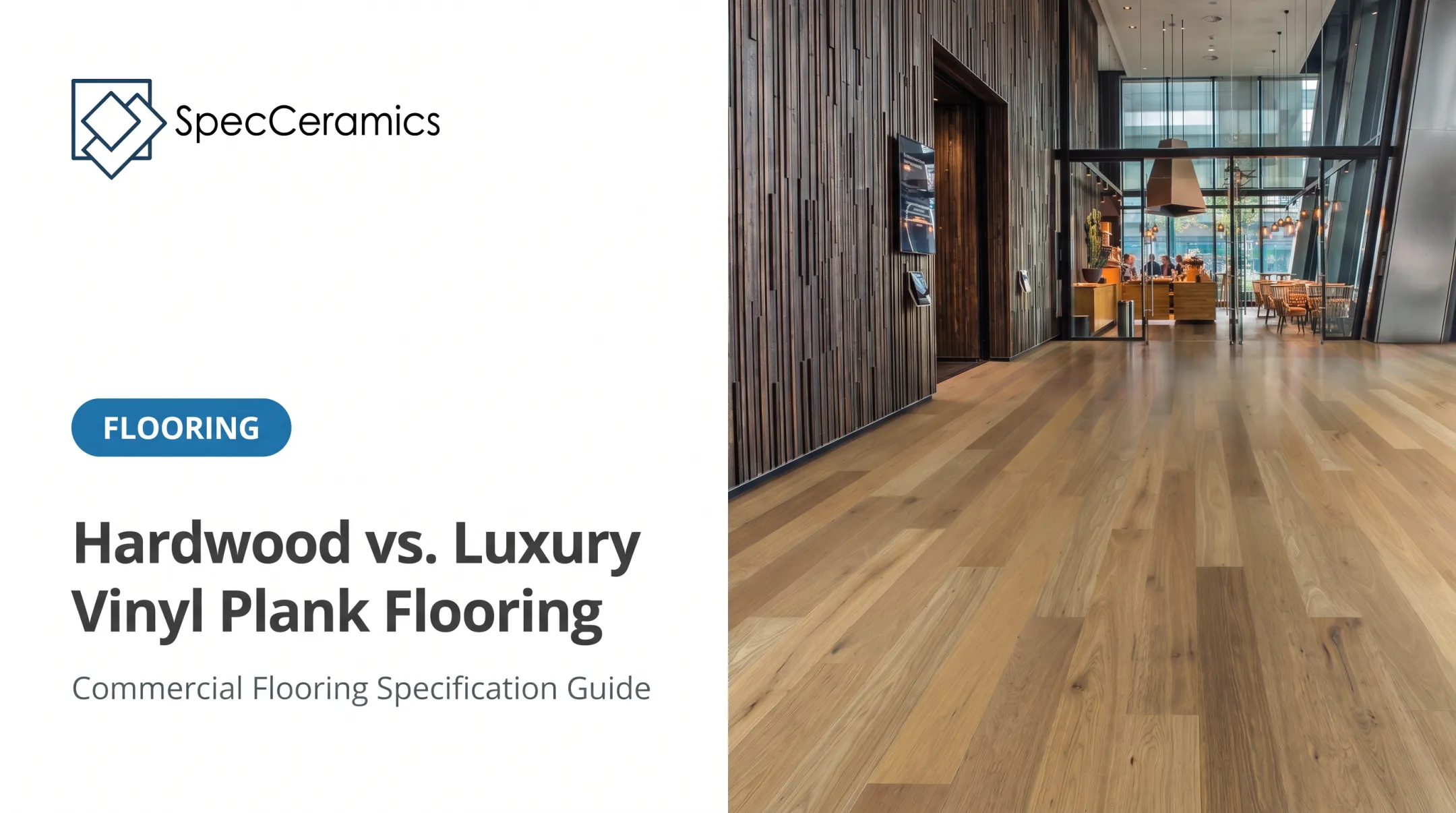
Getting this choice wrong isn't cheap. A mismatched flooring spec can inflate maintenance budgets for years, force early replacement, or shut down a hallway for stripping and waxing when it should be open for business. This guide breaks down composition, cost, durability, and maintenance so you can specify with confidence.
Key Takeaways
- LVT costs more upfront but has a lower 75-year life-cycle cost than VCT
- VCT remains the lower-cost entry point for large commercial rollouts
- Moisture and static-load resistance favor LVT; VCT needs sealing and finish maintenance
- Wood- and stone-look design options favor LVT over VCT
- Match the floor to your budget structure—upfront cost versus long-term maintenance
LVT vs VCT: Quick Comparison
| Factor | LVT | VCT |
|---|---|---|
| Initial installation | ~$4.56/sq ft | ~$3.09/sq ft |
| 75-year life-cycle cost | ~$131.66/sq ft | ~$159.48/sq ft |
| Annualized cost | ~$1.76/sq ft | ~$2.13/sq ft |
| Estimated useful life | 15 years | 15 years |
| Composition | Multi-layer, vinyl-based construction | Vinyl resin and limestone-filler composite |
| Maintenance | Sweep/damp mop; polish optional | Periodic waxing, stripping, recoating |
| Design range | Wood, stone, abstract visuals | Standard tile sizes, tonal colors |
These figures come from a light-to-medium commercial office-use life-cycle cost study. VCT costs less on day one; LVT costs less over the life of the floor.

What is LVT Flooring?
LVT, or Luxury Vinyl Tile, is a layered vinyl flooring product built to mimic wood, stone, and other natural materials while performing better than those materials in wet or high-traffic areas. You'll find it in healthcare corridors, retail floors, and residential kitchens alike.
Layer-by-Layer Construction
A typical LVT product is built from:
- Backing layer — stabilizes the product and supports dimensional flatness
- Core layers — provide body, thickness, and comfort underfoot
- Printed design film — delivers the realistic wood, stone, or abstract visual
- Clear wear layer — protects against scratches and supports cleanability
Some collections push the build further:
- Justify — rigid waterproof LVT with pure virgin vinyl and 60% stone aggregate; 10-year commercial finish and 20-year structural warranties
- Favorable — waterproof line with a 20-mil wear layer, Surface Guardian Pro finish, and embossed wood textures
Installation formats vary by product:
- Glue-down (common in commercial specs)
- EZ-lock click / rigid-core (Justify, WoodChic)
- Loose-lay with friction-grip backing (select commercial lines)

Use Cases of LVT
LVT fits naturally into spaces where design matters as much as performance:
- Retail environments and contemporary boutiques
- Healthcare settings needing wear and heat resistance (including Village's PVC-free line)
- Residential kitchens and bathrooms where moisture resistance is non-negotiable
That mix of durability and low upkeep also shows up in long-term cost. One life-cycle comparison put LVT at $131.66 per square foot over 75 years — roughly $28 less than VCT — even though LVT often costs more upfront. Most of that gap comes from lower ongoing maintenance.
What is VCT Flooring?
VCT, or Vinyl Composition Tile, has been a staple of commercial construction for decades. It's classified under CSI designation 09 65 19.19 and remains one of the most specified flooring types in institutional buildings.
Unlike LVT's layered build, VCT is a homogeneous composite of vinyl resin, plasticizers, mineral fillers, and limestone. Many VCT products carry color and pattern all the way through the tile, meaning surface wear doesn't necessarily expose a different-looking substrate underneath.
Standard format: VCT ships primarily in 12" x 12" tiles, with some strip formats available in larger commercial lines. That standardization keeps material costs predictable for big rollouts, but it also limits design flexibility compared to LVT's wide visual range.

Use Cases of VCT
VCT still commands enormous square footage in:
- K-12 schools and university buildings
- Hospital corridors and back-of-house healthcare space
- Retail back-of-house and warehouse-adjacent areas
The appeal is straightforward math. In the 75-year life-cycle study, VCT's initial installation cost of $3.09 per square foot was the lowest entry point among the flooring types compared.
That same study found VCT ranked as the most expensive option across all eight combinations of discount rate and study period once maintenance was factored in. That's the trade-off: cheap to install, costlier to keep looking good.
LVT vs VCT: What is Better?
There's no universal winner here. The right choice comes down to four variables:
- Total budget structure: Is your capital budget separate from your operating/maintenance budget?
- Design requirements: Does the project need wood or stone visuals, or will standard tile colors work?
- Foot and rolling traffic: Commercial spaces see more cart rolling and pedestrian volume than residential ones.
- Maintenance staffing: Do you have (or want) a team capable of running a polish/recoat/strip cycle?
Match those variables to the flooring type that fits your project:
Choose VCT if:
- Minimizing upfront material cost is the priority
- You have maintenance staff and a finish-maintenance program in place
- The project is a large-footprint, budget-driven build (schools, hospital corridors)
Choose LVT if:
- Lowering long-term costs and maintenance labor matters more than day-one price
- You need design flexibility beyond standard tile sizes
- Moisture resistance or static-load performance is a factor

For projects that need natural material aesthetics beyond what vinyl can deliver, stone-look or wood-look porcelain and ceramic tile are worth a look too.
SpecCeramics' showroom and design-library resources help architects and designers compare these hard-surface alternatives side-by-side with vinyl options before finalizing a spec.
Real World Example: Making the Switch
Life-cycle cost—not day-one install price—is where the VCT-versus-LVT trade-off shows up. A published 75-year cost analysis of 18 flooring types under light-to-medium commercial office conditions reported:
| Flooring | Install | Life-cycle cost | Annualized |
|---|---|---|---|
| VCT | $3.09/sq ft | $159.48/sq ft | $2.13/sq ft |
| LVT | $4.56/sq ft | $131.66/sq ft | $1.76/sq ft |
Once installation, replacement, and custodial maintenance were combined, VCT ranked as the most expensive option in all eight sensitivity-analysis scenarios. For a facility manager comparing bids, that life-cycle figure matters more than the sticker price.
On a 20–30 year hold with a lean facilities team, the annualized gap compounds quickly. On a tight capital budget with maintenance crews already in place, VCT’s lower entry cost can still win the bid.
Before you lock the spec, walk the traffic patterns and maintenance capacity with a surface-materials specialist. SpecCeramics helps commercial and A&D teams compare LVT options, pull samples, and price the full scope before the bid set goes final.
Conclusion
The right choice between LVT and VCT depends on how your budget is structured, how much maintenance capacity you have, and how important design flexibility is to the project. VCT keeps upfront costs low and remains proven in schools and healthcare corridors. LVT costs more to install but reduces the labor and lifecycle expense tied to waxing and stripping.
That decision shapes total cost of ownership, how much downtime your facility absorbs for maintenance, and how the space looks five, ten, or twenty years from now. Match those factors to your project requirements before you lock in a spec.
Frequently Asked Questions
Is LVT more expensive than VCT?
Yes, upfront. LVT typically costs more per square foot to install, but its lifecycle cost tends to run lower thanks to reduced maintenance needs over time.
Which is better, VCT or LVT?
It depends on your budget structure and maintenance capacity. VCT wins on low upfront cost; LVT wins on lower lifecycle cost.
Is VCT more durable than LVT?
LVT generally offers better moisture resistance and static-load performance. VCT can be durable too, but it's more porous and needs sealing to hold up over time.
Do you wax VCT flooring?
Yes. VCT typically requires an initial finish application plus ongoing recoating and periodic stripping to keep its look and protection.
Is VCT considered resilient flooring?
Yes, VCT is a category of resilient flooring alongside LVT, sheet vinyl, and rubber flooring, commonly specified in commercial and institutional buildings.
What is the lifespan of resilient flooring?
Estimated useful life for both LVT and VCT is commonly cited around 15 years in commercial life-cycle studies, though actual lifespan varies with traffic and upkeep.